
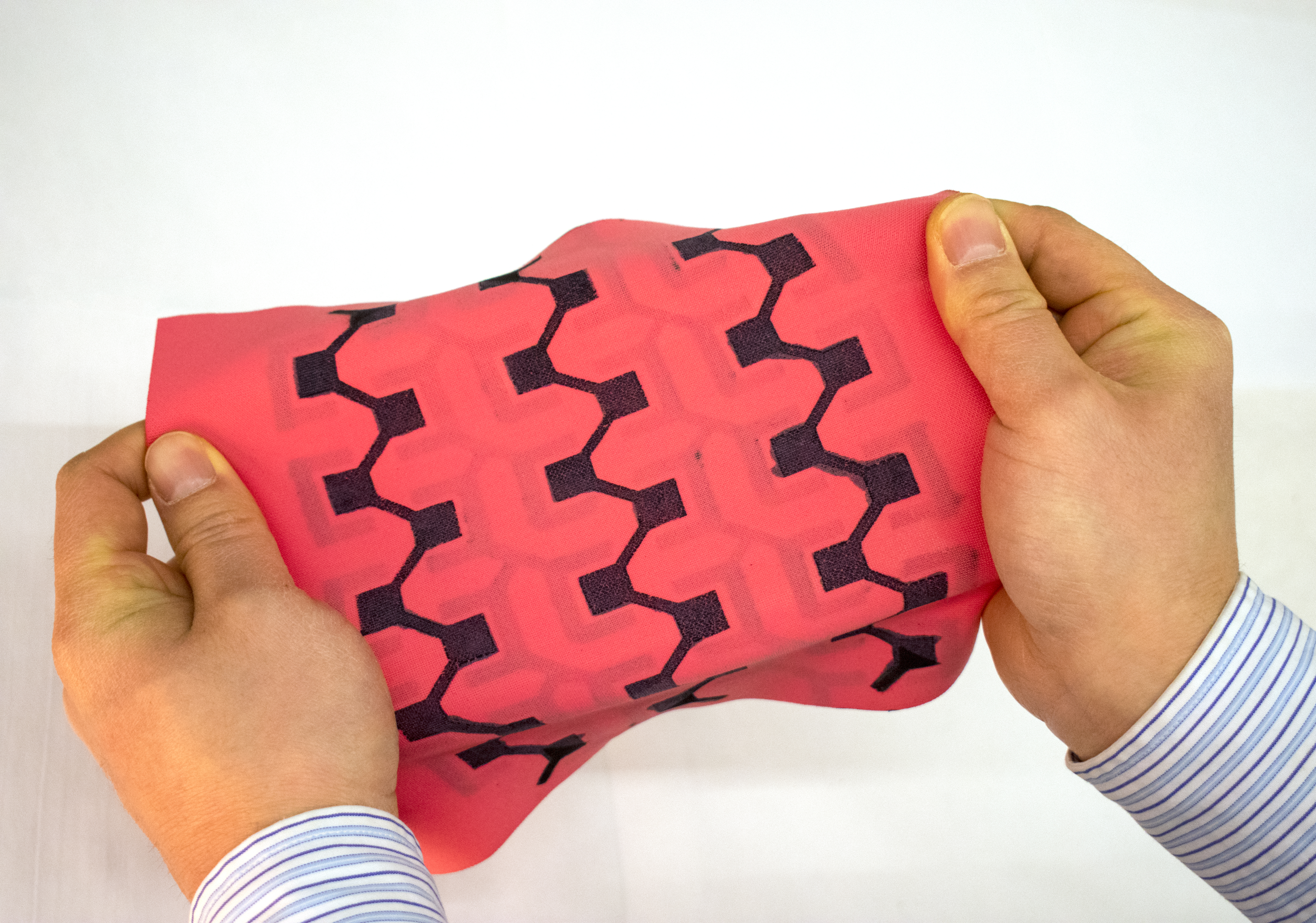
Textile-based wearable electronics have recently emerged as a promising platform for next-generation, ubiquitous health monitoring. Even under extreme mechanical deformation, their flexible and stretchable characteristics allow conformal and reliable contact with asymmetrical and nonuniform human skin while maintaining user comfort.
Highly conductive and reliable textile-coating techniques have advanced wearable sensing capabilities for collecting physical, chemical, and biological information from the human body in real time. These developments have accelerated the evolution of flexible and stretchable electronics for a wide range of applications in human health, safety, and security.
A central challenge, however, is creating a truly self-reliant and stand-alone wearable sensing system that does not depend on an external power source. Traditional battery-operated wearable devices cannot support long-term advanced functionality because of finite energy budgets, and conventional batteries remain too bulky, rigid, and heavy for thin, lightweight, fabric-based systems. Even newer flexible energy-storage devices, such as supercapacitors and lithium-ion batteries, still face limitations in energy capacity and frequent recharging requirements.
Emerging energy-harvesting technologies offer a path toward self-powered wearable systems with low power demand and potentially continuous energy supply. Solar, thermal, and motion-based harvesting methods have all shown promise, but each depends strongly on environmental conditions or user activity. Photovoltaic systems can be interrupted at night or on cloudy days, while thermoelectric, piezoelectric, and triboelectric approaches rely on body heat, motion, or ambient conditions that are not always available at practical levels.
Biological fuel cells (BFCs) provide an alternative approach that has attracted increasing attention for wearable electronics. By using enzymes or microorganisms to scavenge biochemical energy from body fluids such as sweat, saliva, blood, and tears, BFCs offer a biologically compatible route to self-sustaining wearable power. Because they can be built entirely from biodegradable organic materials, they also present strong advantages in biocompatibility, disposability, and environmental sustainability.
← Back to Research